

DIA Submission to the Public Consultation on Australia’s Next National Cultural Policy
The Design Institute of Australia lodged its submission to the public consultation on Australia’s next National Cultural Policy on 22 May 2026. Authored by CEO Simone LeAmon, the submission builds on Creative Australia’s renamed Visual Arts, Craft and Design Partnership Framework (VACDPF, 2025) and advances a clear proposition: that the recognition of design already embedded within Australia’s cultural policy architecture must now be matched by policy settings proportionate to the scale, significance and contemporary scope of the practice itself.
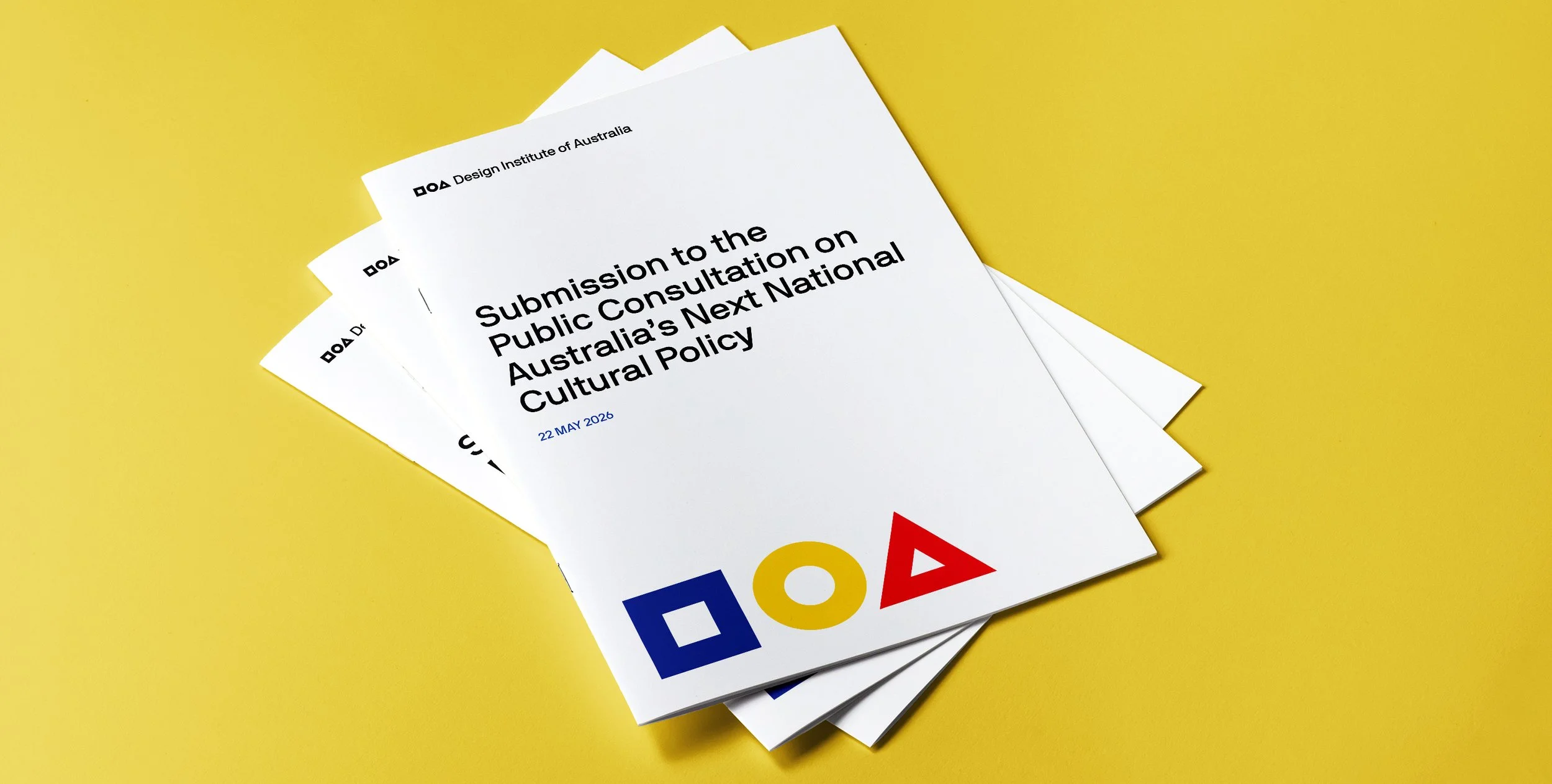
Drawing on the Government’s own evidence, including design’s $67.5 billion contribution to GDP, the Australian Bureau of Statistics’ 2024 recognition of Design Professionals as a standalone Minor Group within the national occupation framework, and findings from DIA’s national Make Design Count consultation (February–March 2026), the submission argues that design is simultaneously a profession, a strategic capability, an enabler of economic prosperity, and a cultural practice; roles that are not mutually exclusive but deeply interconnected.
It calls for design to be recognised in its full contemporary scope and embedded as a thread woven across all five pillars of the next National Cultural Policy. It also outlines eight recommendations, spanning a Designed in Australia provenance framework through to a companion National Design Policy and Cultural Infrastructure Framework and a National Design Audience and International Engagement Strategy.
DIA submits these recommendations not in pursuit of inclusion at the margins of cultural policy, but in service of a national cultural policy that accurately reflects the country it is written for, one that recognises design as a principal way culture is shaped, experienced and continually renewed across contemporary Australian life.
This is not a question of introducing design into cultural policy. It is a question of bringing federal cultural policy into alignment with contemporary Australia.
Understanding Design’s Place in Cultural Policy
To question whether design belongs within cultural policy is increasingly to misunderstand the nature of culture itself. Culture is not only what a nation preserves, exhibits or performs; it is also what a nation builds, creates and encounters in everyday life.
Design is the form through which culture is most consistently experienced in civic life; shaping the environments, systems, objects, services and interactions that define how we live, connect and participate in society. At its core, design’s greatest power lies in its purpose: to drive meaningful change and impact. It is a profession, a cultural practice, a strategic capability and an enabler of economic prosperity. These roles are not mutually exclusive. Design contributes to innovation, industry and productivity precisely because it is deeply embedded within the cultural and social fabric of contemporary life.
A progressive cultural policy recognises that public engagement with culture increasingly occurs through multiple forms and experiences, not solely within traditional cultural institutions, but through the designed environments, technologies, communications and everyday encounters that shape contemporary existence. Design influences how people experience public space, access services, engage with technology, navigate information and understand identity, place and belonging.
To recognise design within cultural policy is therefore not to stretch the definition of culture, but to acknowledge how culture itself is evolving and being experienced. Design is both an expression of culture and a mechanism through which cultural values are made visible, tangible and actionable in the world.
And culture is the shared way of life of people, expressed through what they value, create, and practice every day.