

NSW Government Response Falls Short on Interior Designer Recognition
Australia risks falling behind Asia Pacific neighbours as NSW declines to establish registration pathway, threatening regional professional mobility
The Design Institute of Australia (DIA) has expressed its disappointment at the NSW Government’s response to the Parliamentary recommendation to establish a registration and licensing pathway for interior designers.
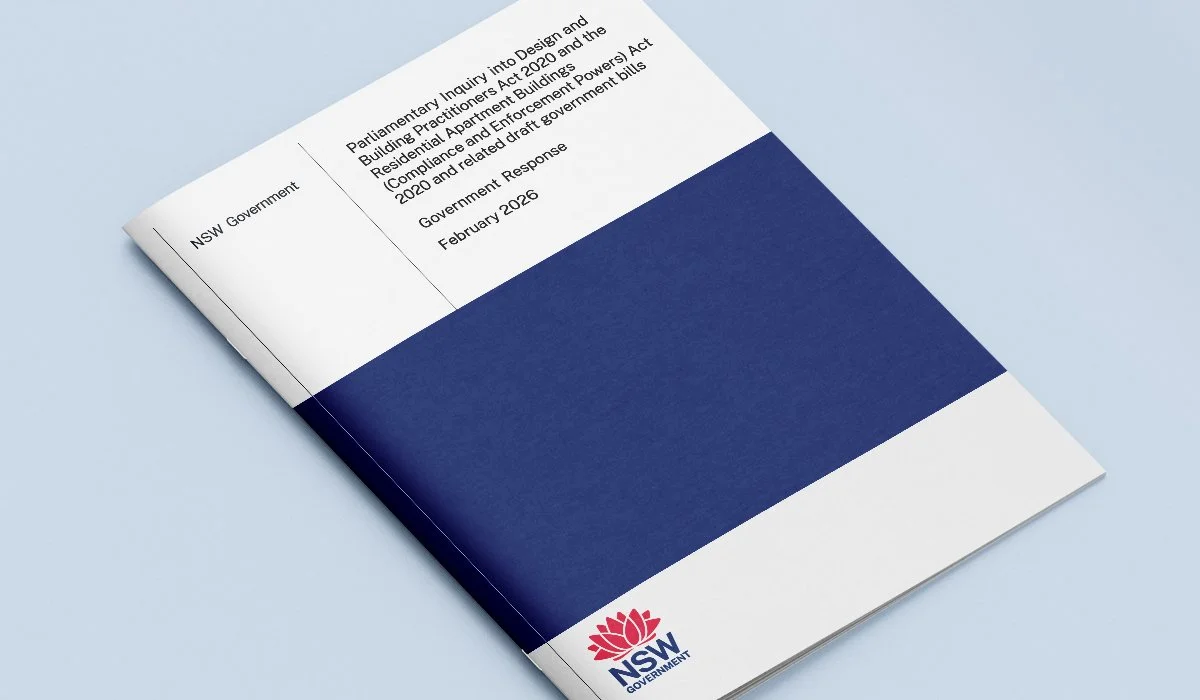
In its formal response to the Legislative Council Public Accountability and Works Committee’s Review of the Design and Building Practitioners Act 2020, released today, the NSW Government merely “Noted” the Committee’s Recommendation 2, which called for the Government to consider establishing a pathway to registration and licensing for interior designers.
The Government’s response reaffirms its position that interior design work falls outside the scope of the building safety regulatory framework, stating that such work should be “integrated into the designs done by registered architects and building design practitioners.”
DIA CEO Simone LeAmon said the response was a missed opportunity for New South Wales. “The Committee heard extensive evidence about the contribution interior designers make to building safety and quality, and made a clear recommendation. It is disappointing that the Government has chosen to note rather than act on that recommendation,” Ms LeAmon said.
Victoria Already Leads the Way
The NSW Government’s reluctance to recognise interior designers stands in stark contrast to Victoria, which already provides a formal registration pathway for the profession. The Victorian Building Authority (VBA) maintains a specific registration class – Building Designer, Building Design (Interior) – that recognises interior designers as registered building practitioners.
Victorian-registered interior designers must hold recognised qualifications and a minimum of two years’ practical experience. They are authorised to prepare technical interior design drawings for all building classes, initiate building permit applications, and administer building contracts. Their work is regulated, their qualifications verified, and consumers are protected.
“Victoria has demonstrated that interior designers can be successfully integrated into a building practitioner registration framework. If it works in Victoria, there is no principled reason it cannot work in New South Wales,” Ms LeAmon said.
“The NSW Government’s own response to the Committee emphasises the importance of nationally consistent registration frameworks. Yet by refusing to recognise interior designers, New South Wales is actively creating inconsistency with Victoria, where the profession is already regulated.”
Australia Falling Behind the Asia Pacific
The lack of recognition is not only an interstate inconsistency – it places Australia behind several of its Asia Pacific neighbours, where interior design is increasingly treated as a regulated profession essential to building quality, consumer protection and international trade competitiveness.
Malaysia has the most comprehensive framework in the region. Interior designers are registered through the Board of Architects Malaysia (Lembaga Arkitek Malaysia) under the Architects Act 1967. Registration is not optional – it is a legal requirement. Practising as an interior designer without registration is a criminal offence carrying fines of up to RM50,000 (approximately AUD $17,000) or imprisonment of up to two years. Interior designers must pass the Interior Design Licensure Examination and maintain their registration with LAM to practise lawfully.
The Philippines enacted dedicated legislation – the Philippine Interior Design Act of 2012 (Republic Act No. 10350) – which established a Board of Interior Design within the Professional Regulation Commission. Filipino interior designers must pass a national licensure examination and hold a valid professional licence. The legislation explicitly recognises interior design’s “important role in nation building” and requires that interior plans and specifications for buildings are prepared by or under the supervision of a licensed interior designer. Penalties for unlicensed practice include fines of up to one million Philippine pesos or imprisonment.
Singapore has developed the Singapore Interior Design Accreditation Scheme (SIDAS), a government-supported initiative developed through the DesignSingapore Council’s 2018 Industry Transformation Roadmap. The scheme classifies interior designers across accreditation levels based on qualifications and experience, requires continuing professional development, and is increasingly being referenced as a tender prerequisite by developers and commercial clients.
Indonesia provides professional certification for interior designers through the Himpunan Desainer Interior Indonesia (HDII), which administers the Sertifikat Keahlian (SKA) certification system. Notably, Indonesia and the Philippines signed a Mutual Recognition Arrangement for interior design services in 2023, enabling cross-border professional mobility for certified practitioners – a level of regional integration that Australia is not yet positioned to participate in.
These regional developments are not occurring in isolation. They are being coordinated through the Asia-Pacific Space Designers Association (APSDA), which brings together professional interior design organisations from 15 countries across the Asia Pacific. DIA is a Board Member of APSDA and supports its Asia Pacific Interior Designers’ Accreditation Program (AP-ID-AP) – the first and only initiative providing mutual recognition of professional interior designers across the broader Asia Pacific region.
As global trade relationships shift and Asia Pacific nations grow in economic influence, these regional accreditation frameworks are creating pathways for professional mobility – pathways that Australian interior designers risk being excluded from if they lack a domestic recognition framework that can align with regional standards.
“When Malaysia, the Philippines, Singapore and Indonesia are all moving to recognise and regulate interior design professionals, it is difficult to understand why New South Wales continues to exclude them from its building practitioner framework,” Ms LeAmon said.
“These countries recognise what should be self-evident: that interior designers who specify materials, plan layouts that affect fire egress and accessibility, and interface with building compliance requirements are making decisions that directly impact building safety. Regulating those practitioners protects consumers. Leaving them outside the framework creates a gap.”
DIA Director, Dr Natalie Wright said the Institute’s work with APSDA underscored the urgency of the issue. “DIA is currently working with likeminded professional interior design organisations in 14 other countries in the Asia Pacific region to ensure that professional interior design is elevated and recognised, paving the way for mobility of the profession within the region,”
“As part of this work, we are following each country’s accreditation status and are acutely aware that Australia is well behind some of the developing countries in Asia in their journey. DIA is committed to ensuring that Australian designers are not negatively impacted by the shortsightedness of a state-based building authority regime and can remain part of a respected interior design economy with productivity growth potential in the larger Asia Pacific region.”
A Gender Equity Contradiction
The exclusion of interior designers from the NSW building practitioner framework also raises significant gender equity concerns. Interior design is one of the most female-dominated professions in the Australian built environment sector, with women comprising approximately 76 per cent of practising interior designers – a figure DIA’s own data confirms. By contrast, the construction and building sector remains overwhelmingly male-dominated.
The NSW Government has recognised this gender imbalance and is actively investing in programs to address it. Infrastructure NSW’s Women in Construction Program has allocated $5.9 million in funding over two years to 34 innovative initiatives aimed at removing obstacles to women entering or staying in the construction sector. The program is piloting increased targets for women in trade and non-traditional roles across 23 major government infrastructure projects, with dedicated onsite project officers supporting female employment and retention. The NSW Government’s “Hard Work Knows No Gender” campaign, launched in 2023, further signals its commitment to increasing women’s participation in the building industry.
Queensland has adopted a parallel approach, setting a target of 11 per cent female participation in frontline roles on government projects, supported by a 2025 regulatory mandate for designated female amenities. Programs including the NAWIC QLD Women on Tools Strategy, the CSQ Women in Construction Strategy, and the Master Builders’ Emerging Women in Construction mentoring program are all designed to attract, recruit and retain women in the building sector.
“There is a fundamental contradiction in the NSW Government’s position,” Ms LeAmon said. “On one hand, the Government is investing millions of dollars and dedicating significant policy effort to bring more women into the building and construction sector. On the other hand, it is refusing to recognise interior design – a profession where women already represent more than three-quarters of practitioners – within its building practitioner framework.
“You cannot champion women’s participation in the built environment while simultaneously excluding the largest female-dominated building profession from your regulatory framework. If the Government is serious about gender equity in construction, recognising interior designers would be one of the most immediate and impactful steps it could take.”
2026 Reforms: A Window of Opportunity
Despite the disappointing response, DIA noted that the Government has committed to bringing a Building Productivity Reforms package to Parliament in 2026, with commitments to targeted stakeholder consultation.
The Government’s own data shows that serious building defect rates have fallen from 59 per cent for buildings occupied in 2019 to just 17 per cent for those occupied in 2022, with the 2025 Strata Defect Survey confirming this trend. DIA argues that extending the regulatory framework to include interior designers would strengthen these outcomes further.
“We acknowledge the Government’s commitment to continue working with the interior design industry, and we intend to hold them to that commitment,” Ms LeAmon said. “DIA will be seeking a seat at the table for the 2026 building reforms consultation. We will be bringing a detailed proposal for an interior design registration pathway that is proportionate, practical, and aligned with the Government’s own consumer protection and productivity objectives.
“Our members are degree-qualified professionals who complete 50 continuing professional development points every year. They are ready to be regulated. The question is whether New South Wales is ready to join Victoria – and our regional neighbours – in recognising them.
“We respectfully urge continued consideration of a framework that supports professional recognition for interior designers. A well-structured accreditation pathway aligned with APSDA’s AP-ID-AP would enhance consumer protections, elevate design quality, and strengthen Australia’s international competitiveness in a rapidly evolving market. By fostering collaboration between government, industry bodies, and education providers, we can establish transparent standards, clearly defined competencies, and accessible pathways for ongoing professional development. This approach will not only safeguard the public interest but also position Australian interior design on the world stage.”