

DIA leads one of Australia’s largest design advocacy campaigns
DIA has formally lodged its submission to the Australian Bureau of Statistics (ABS) for the OSCA 2027 Update, the national framework that defines how every occupation in Australia is recognised, measured and valued.
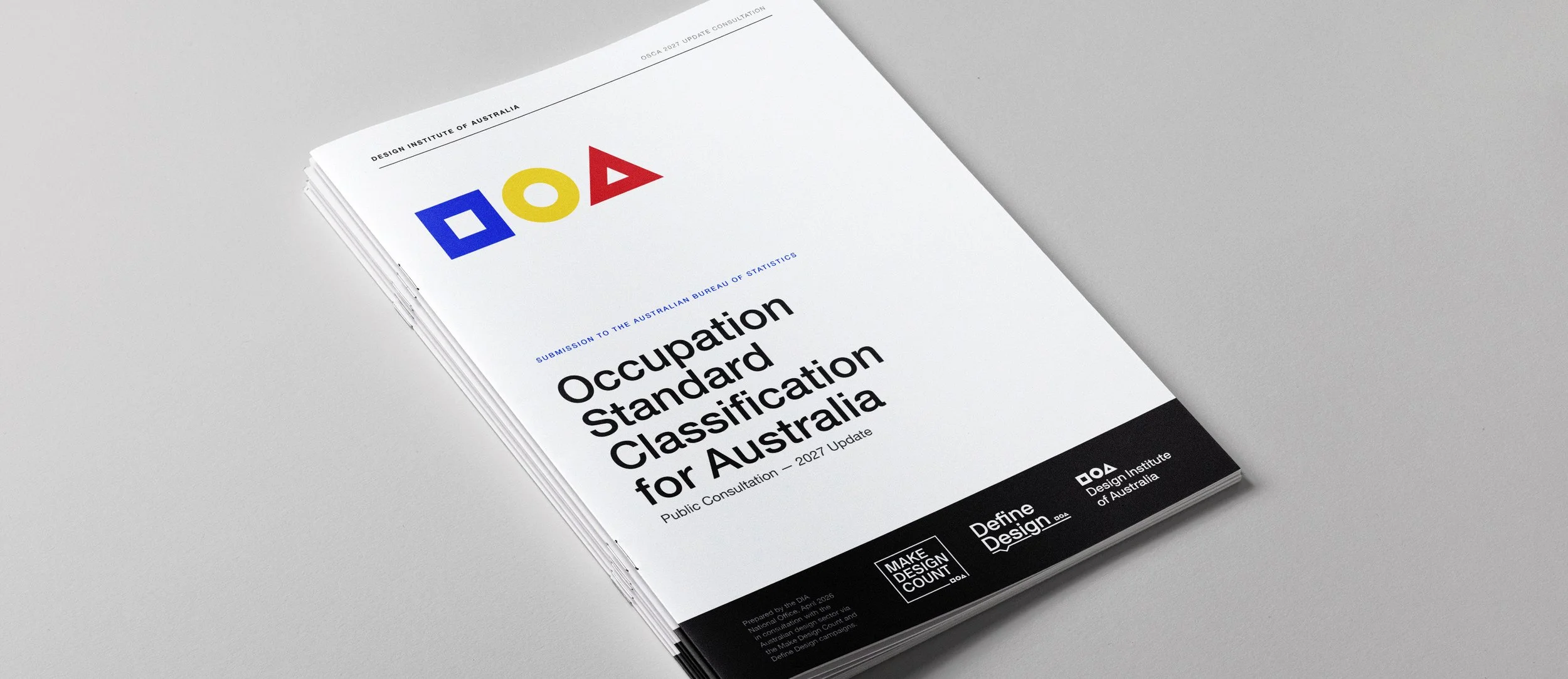
This submission represents one of the most significant advocacy initiatives undertaken for the design profession in recent years. It is the result of extensive consultation, rigorous analysis and, most importantly, the collective input of the design community itself.
Through the DIA’s Make Design Count and Define Design campaigns, more than a thousand designers from across Australia contributed their insights, experiences and expertise to help shape the future of the profession. The submission is now available to read and explore and is a powerful reflection of designers voices, practices and the evolving direction of design in Australia.
Why this matters
At first glance, occupational classification may seem technical or administrative. In reality, it is foundational.
OSCA is the Occupation Standard Classification for Australia, underpinning how professions are defined within the national economy. It informs workforce data, shapes migration pathways, influences education and training systems, and guides policy and funding decisions. It also determines how professions are understood by employers, government and the broader public.
For design, this has profound implications.
When occupation definitions are outdated, incomplete or misaligned with contemporary practice, the consequences are far-reaching. Designers may find their skills misunderstood or undervalued. Employers may struggle to identify appropriate talent. Education providers may be misaligned with industry needs. Policymakers may lack the data required to invest effectively in the sector.
Put simply, if design is not accurately classified, it is not accurately counted — and if it is not counted, it does not count. This submission seeks to address that.
A profession that has evolved
The recommendations put forward by the DIA reflect the considered views of practising designers working across disciplines, sectors and career stages. They represent the minimum changes necessary to ensure that Australia’s official occupation classification accurately reflects the contemporary design workforce.
Over the past two decades, design has undergone profound transformation. Digital technologies have reshaped how design is conceived and delivered. Interdisciplinary practice has become the norm. New fields have emerged at the intersection of design, strategy, systems thinking and service delivery. Design is no longer confined to discrete outputs. It operates across systems. It informs decision-making. It shapes services, experiences and environments at scale. Yet, in many cases, national classification frameworks have not kept pace. The DIA’s submission responds directly to this gap.
What the submission proposes
The submission addresses three key areas:
Amendments to ten existing occupation profiles within Minor Group 242 Design Professionals, ensuring that their descriptions and task lists reflect contemporary practice.
The formal inclusion of two new occupations Service Designer and Strategic Designer recognising the growing importance of these roles across government, industry and the broader economy.
Supporting evidence and analysis outlining the workforce, education, migration and policy implications of misaligned classification.
These recommendations have been carefully developed to align with OSCA formatting conventions, ensuring clarity, consistency and usability within the broader framework. They are not aspirational. They are pragmatic. They describe what designers are already doing.
A community-led process
Central to this work has been the engagement of the design community. The Make Design Count campaign, conducted in early 2026, invited designers across Australia to reflect on how accurately OSCA currently represents their occupation, how their practice has evolved, and how emerging forces, including artificial intelligence, are reshaping their work. The response was significant. The campaign generated 672 survey responses, capturing a diverse and representative cross-section of the profession.
This built on the earlier Define Design campaign in 2024 and Part 2 in early 2026. Together, these initiatives attracted over 400 responses and laid important groundwork for understanding the emerging design occupations in Australia, specifically Service Design and Strategic Design.
Together, these campaigns represent one of the most comprehensive recent efforts to capture the current state of the design profession nationally. Their findings were then tested and refined through expert panel reviews and workshops spanning thirteen design disciplines, bringing together practitioners, educators and industry leaders. The result is a submission that is both evidence-based and community-led.
The economic and societal value of design
Design is not a niche activity. It is a significant contributor to Australia’s economy and a critical driver of innovation. Industry estimates place the economic impact of design at more than $67.5 billion annually when accounting for design activity across sectors.
But its value extends beyond economics.
Design shapes the environments we inhabit, the systems we rely on, the services we access and the products we use. It influences how we move through cities, how we engage with technology, how we experience healthcare, education and public services.
It is, fundamentally, a form of infrastructure. Not physical infrastructure alone, but cognitive, cultural and systemic infrastructure, shaping how society functions and evolves.
When design is not accurately represented within national classification frameworks, its contribution is diminished. Its workforce is undercounted. Its role in shaping economic, social and civic outcomes is undervalued.
Ensuring that design is clearly defined and appropriately classified is therefore not only a matter of professional recognition, it is a matter of national importance.
Looking ahead
The DIA’s submission is both a reflection of where the profession is today and a foundation for where it is going. It seeks to ensure that Australia’s classification systems recognise the full scope of design practice, support the development of the workforce, and enable the profession to contribute effectively to national priorities.
This includes areas such as:
Advanced manufacturing and product innovation
Digital transformation and public service delivery
Housing and the built environment
Sustainability and circular economy initiatives
Accessibility and inclusive design
Accurate classification is essential to enabling design to play its full role in these domains.
A shared achievement
This submission is the result of collective effort. It reflects the voices of more than a thousand designers who contributed their time, insights and expertise. It draws on the knowledge of expert panels and the dedication of those working across the profession to ensure that design is recognised for what it is and what it does.
It also reflects the DIA’s role as the national voice for designers, advocating for the profession, supporting its members and ensuring that design is positioned at the centre of conversations about Australia’s future.
What happens next
The ABS will now review submissions as part of the OSCA 2027 Update process, with outcomes expected to be released in late 2026. The DIA looks forward to continued engagement with the ABS throughout this process, and to working collaboratively to ensure that the final framework accurately reflects the contemporary design workforce.
Read the submission
The full submission is now available to read and explore. It is a detailed account of the profession as it stands today, its scope, its evolution and its future direction.
And it is how we ensure that design is counted — and that designers count.